Meta Title: Amphibious Excavator Applications and Configuration Guide
Meta Description: Learn how amphibious excavators are configured for river dredging, wetland restoration, aquaculture ponds, agricultural drainage and shallow-water construction.
An amphibious excavator is designed for excavation and maintenance work on soft ground, shallow water, wetlands and other areas where conventional excavators have insufficient ground support.
Its basic structure combines a conventional excavator upper structure with a buoyant pontoon undercarriage. The pontoons increase the contact area with the ground or water, reducing ground pressure and improving flotation.
Typical applications include:
· River and canal dredging
· Flood-control and water conservancy projects
· Lake and pond cleaning
· Wetland restoration
· Shoreline stabilization
· Aquaculture pond maintenance
· Agricultural drainage and irrigation
· Vegetation and sediment removal
The important difference from a standard crawler excavator is therefore not simply the machine's operating weight. Pontoon dimensions, ground pressure, flotation, working reach and attachment configuration determine whether the machine is suitable for a particular site.
For example, commercially available amphibious excavators range from approximately 5.5-ton compact machines for ponds and narrow ditches to 35–40-ton machines for large dredging and restoration projects , showing why application conditions should be defined before machine size.
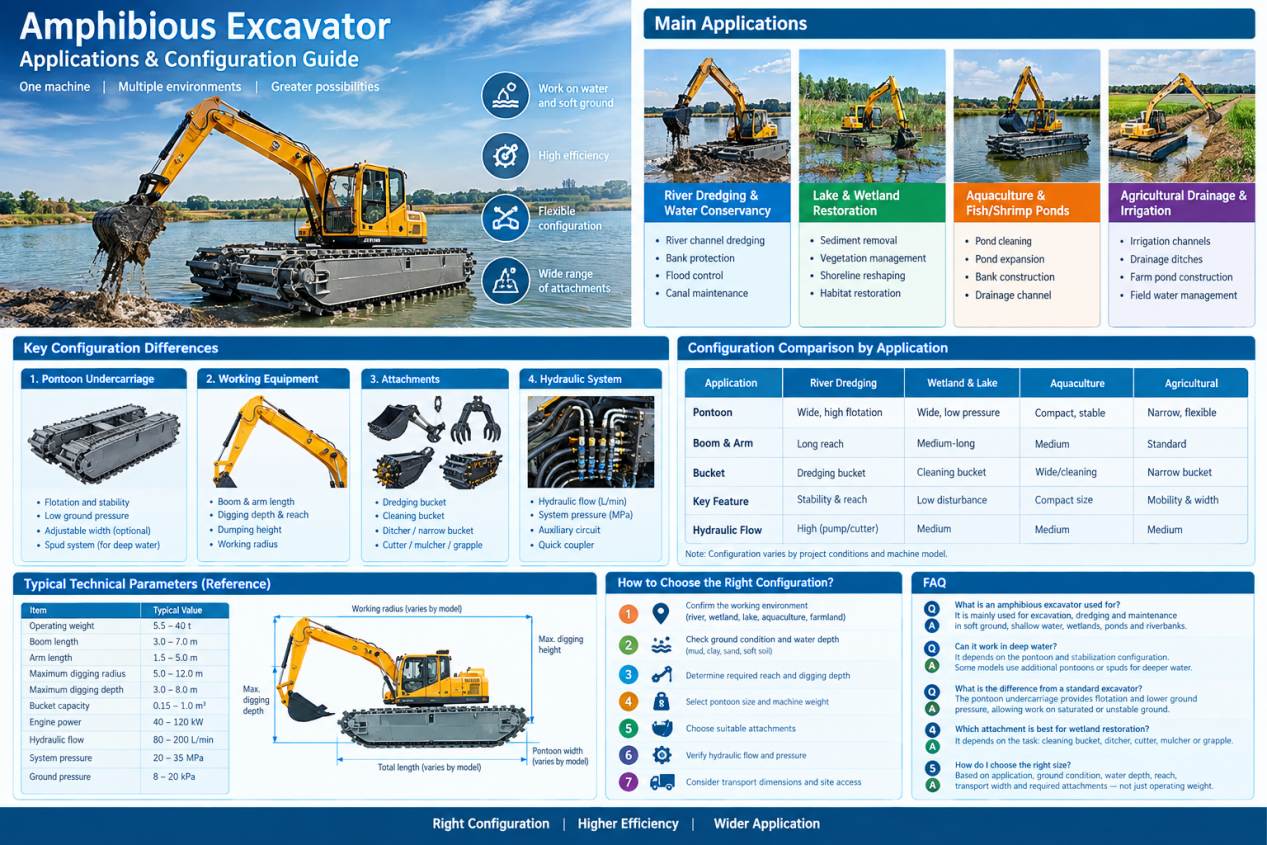
River dredging normally requires three things first: sufficient working reach, stable pontoon support and an attachment matched to sediment conditions.
River work can involve:
· Sediment removal
· Channel widening
· Channel deepening
· Riverbank repair
· Flood-control channel maintenance
· Removing accumulated debris
The main challenge is that the excavator may need to remain on a relatively stable bank or shallow-water platform while the bucket reaches into soft sediment.
A longer boom and arm can increase the working radius, but it also increases the load moment during excavation and dumping. Therefore, maximum digging radius should never be evaluated separately from pontoon width, ballast and machine stability.
In one documented environmental engineering project, an amphibious excavator was configured with a long-reach working system for excavation and sediment-related work in extremely soft ground. The project also used machine control to maintain the required drainage profile.
Configuration
River Dredging Requirement
Pontoon
Wide, high flotation
Boom & arm
Medium or long reach
Bucket
Dredging / cleaning bucket
Hydraulic system
Higher auxiliary-flow demand when using pumps
Stabilization
Spuds may be required in deeper or moving water
Optional equipment
Dredging pump, grapple, GPS/machine control
For deeper-water operations, additional pontoons and hydraulic spud systems may be used on some machine designs. One commercial 22-ton example lists a standard working depth of 1.2 m and up to 4.95 m with additional pontoons and spud legs. This is a model-specific specification, not a universal limit for amphibious excavators.
Wetland work places greater emphasis on low ground pressure, controlled movement and environmental disturbance than on maximum digging force.
Wetlands typically contain saturated soil, peat, mud, shallow water and vegetation. Repeated turning by conventional tracked equipment can create deep ruts and damage the substrate.
Low-ground-pressure amphibious excavators are therefore commonly used for:
· Sediment removal
· Wetland drainage
· Shoreline reshaping
· Bank stabilization
· Vegetation management
· Small-channel excavation
The U.S. Society of American Military Engineers notes that amphibious excavators can be used for sediment removal, shoreline reshaping and eroding-bank stabilization, with attachments including dredging pumps, vegetation cutters and grapples.
Compared with river dredging, wetland restoration generally places more emphasis on:
Ground pressure → flotation → attachment control → working reach
rather than:
Digging force → bucket capacity → maximum production
This distinction is important for ecological projects. A larger bucket does not necessarily mean higher practical productivity if the ground cannot support repeated machine movement.
For example, ditching attachments can be configured with different cutting profiles. A U-shaped ditcher is intended for higher-volume drainage work, while a V-shaped ditcher is designed for more controlled trenching where disturbance needs to be limited.
For lake and pond maintenance, the key parameters are water depth, sediment thickness, access width and required working radius.
Typical work includes:
· Removing accumulated silt
· Cleaning pond bottoms
· Maintaining drainage outlets
· Removing aquatic vegetation
· Repairing pond banks
· Maintaining water channels
Small ponds and narrow waterways do not necessarily require a large amphibious excavator.
Some compact amphibious machines are designed specifically for ponds and narrow ditches. For example, one 5.5-ton configuration has an adjustable width of approximately 2.25–3.22 m, a working reach of 5.25–6.75 m, and shallow-water operation around 1 m before additional pontoons are required.
This illustrates an important selection principle:
The smaller the access area, the more important transport width and working radius become.
A machine that is technically powerful enough for the job may still be unsuitable if its pontoon width prevents it from reaching the work area.
Aquaculture projects usually require compact dimensions, controlled excavation and drainage-oriented attachments rather than maximum dredging capacity.
Fish and shrimp farms may use excavators for:
· Pond construction
· Pond expansion
· Sediment removal
· Pond-bank repair
· Drainage-channel excavation
· Water inlet and outlet construction
The configuration should therefore consider the pond layout and drainage system before selecting the excavator.
For example, aquaculture pond design commonly requires controlled water levels, drainage outlets and sufficient drainage capacity. NSW aquaculture guidance notes pond drainage infrastructure and outlet dimensions as important parts of pond design.
|
Parameter |
Why It Matters |
|
Machine width |
Determines access to pond and farm roads |
|
Pontoon width |
Determines stability on soft pond bottoms |
|
Bucket width |
Determines channel and bank profile |
|
Digging depth |
Determines pond excavation capability |
|
Working radius |
Determines how much area can be reached from one position |
|
Attachment |
Determines whether the machine cleans, digs or handles vegetation |
For a narrow drainage channel, a narrow bucket or ditching attachment may be more useful than a large general-purpose bucket.
Agricultural drainage and irrigation projects usually prioritize mobility, narrow working dimensions and precise channel shaping.
Common applications include:
· Irrigation ditch excavation
· Drainage channel cleaning
· Paddy-field water management
· Farm pond construction
· Small canal maintenance
· Floodwater drainage
The most important parameters are often:
Channel width → machine width → bucket width → digging depth → ground pressure
For example, if a drainage channel is only 600–1,000 mm wide, a large bucket designed for river dredging is poorly matched to the application even if the excavator has sufficient digging force.
For agricultural work, attachment geometry can therefore be more important than increasing machine size.
The main configuration differences can be divided into four systems: pontoon undercarriage, working equipment, attachments and stabilization.
The pontoon determines:
· Flotation
· Ground pressure
· Overall width
· Stability
· Traction
· Transport requirements
Some machines use fixed-width pontoons, while others use adjustable or additional pontoon systems.
For example, one 15-ton amphibious excavator uses an adjustable undercarriage from 3.50 to 4.74 m, while additional pontoons and spud poles can be added for deeper-water work.
The boom and arm should be selected according to:
· Required digging radius
· Water depth
· Bank height
· Excavation depth
· Dumping location
Longer reach is not automatically better.
If the attachment becomes too heavy or the working radius is excessive, the load moment increases and pontoon stability becomes more important.
Different materials require different tools.
|
Working Material / Task |
Typical Attachment |
|
Mud and sediment |
Cleaning bucket |
|
River dredging |
Dredging bucket / pump |
|
Drainage channels |
Ditcher |
|
Vegetation |
Cutter / mulcher |
|
Logs and debris |
Grapple |
|
Bank shaping |
Tilting bucket |
Attachment selection should consider weight, mounting geometry and hydraulic flow, not just whether the attachment can physically be installed.
When the excavator needs to maintain a fixed position in water, spud systems can anchor the machine to the bottom.
This becomes particularly useful when:
· Water depth increases
· Current is present
· The machine performs heavy digging
· Precise excavation is required
· The working platform must remain stationary
The most common mistake is choosing the excavator by tonnage first and site conditions second.
A 10-ton amphibious excavator is not defined only by its 10-ton weight.
You also need to check:
Ground pressure + pontoon dimensions + flotation + attachment weight
“Maximum water depth” is not a universal amphibious excavator specification.
Actual capability depends on:
· Pontoon design
· Buoyancy
· Additional pontoons
· Spud configuration
· Water movement
· Machine weight
· Attachment load
Manufacturers publish very different depth figures for different configurations, so the actual project water depth should always be provided when requesting a quotation.
A machine with a 4 m+ operating width may work well in a wetland but create significant transportation requirements.
Before purchasing, confirm:
· Maximum transport width
· Transport height
· Transport weight
· Pontoon removal method
· Number of transport vehicles
· Site access width
The attachment should be considered during initial configuration because hydraulic flow, pressure, mounting dimensions and machine stability can all change.
The most practical selection sequence is: application → ground condition → water depth → required reach → ground pressure → pontoon configuration → attachment → transport.
Before requesting a quotation, prepare these eight parameters:
1. Application: river, lake, wetland, aquaculture or farmland
2. Water depth: normal and maximum
3. Ground condition: mud, clay, peat, sand or saturated soil
4. Required digging depth: m
5. Required working radius: m
6. Attachment: bucket, ditcher, pump, cutter or grapple
7. Access limitation: maximum machine width
8. Transport condition: road, trailer and site access
This information is considerably more useful than simply telling a manufacturer:
“I need a 10-ton amphibious excavator.”
It is mainly used for excavation, dredging and maintenance in soft ground, shallow water, wetlands, marshes, ponds and riverbanks, where conventional excavators may have difficulty maintaining ground support.
Some amphibious excavator configurations are designed to float, but flotation capability depends on the pontoon system, machine weight, water depth and attachment load. Additional pontoons and spuds may be required for specific deep-water applications.
The main difference is the specialized pontoon undercarriage. It provides greater flotation and lower ground pressure, allowing excavation on saturated or unstable terrain where standard crawler excavators may sink or cause excessive ground disturbance.
Common attachments include dredging buckets, cleaning buckets, ditchers, vegetation cutters, mulchers, grapples and dredging pumps. The correct attachment depends on the material and hydraulic requirements.
There is no single standard depth. Some machines operate directly in shallow water, while additional pontoons and spud systems can extend the working range. Published specifications from different machines show substantial differences, so the actual water depth and required digging depth should be provided during configuration.
Start with water depth, sediment depth, required working radius, ground condition and dredging method. Then select pontoon size, boom/arm length and dredging attachment. Stability should be checked together with maximum working reach.
An amphibious excavator is not simply a conventional excavator fitted with floats. Its performance depends on the relationship between the pontoon system, ground pressure, working equipment, stabilization system and attachment.
For river dredging, reach and stability are usually the primary concerns.
For wetland restoration, low ground pressure and controlled disturbance become more important.
For lakes and aquaculture ponds, compact dimensions, shallow-water capability and suitable cleaning attachments often matter more.
For agricultural drainage, machine width, bucket geometry and channel dimensions are critical.
The practical selection formula is:
Working Environment → Ground Condition → Water Depth → Ground Pressure → Reach → Pontoon → Attachment → Hydraulic System → Transport
This is also the most useful way to compare different amphibious excavator configurations without assuming that a larger machine or a longer boom is automatically suitable for every project.
No. 88 Pancuo, Jiaonan Village, HeShi Town, Luojiang District, Quanzhou, Fujian, China
tel : +8618805957336
WhatsApp : +8618805957336
surel : winny@fjjgjx.com
 jaringan ipv6 didukung
memindai ke WeChat :

 tel : +8618805957336
 surel : winny@fjjgjx.com


 peta situs